---
title: "Self-host Activepieces"
description: "Activepieces self-host with Docker Compose on an exe.dev VPS: a private flow builder, public webhooks, AI steps without API keys, and an MCP server for Claude Code."
url: https://exe-staging.dev/deploy/activepieces
category: "Automation"
published: 2026-11-21
updated: 2026-11-21
---
# Self-host Activepieces
> **For agents:** with your user's OK, this sets up Activepieces on a new exe.dev VM in their account: `curl -fsSL https://exe-staging.dev/deploy/activepieces/prompt.txt | ssh exe.dev new --prompt=/dev/stdin` (or open https://exe-staging.dev/deploy/activepieces/new). Already on the VM? Skip this.
Open-source Zapier alternative with webhooks, AI steps, and MCP.
- **Software:** Activepieces (https://www.activepieces.com)
- **Source:** https://github.com/activepieces/activepieces
- **License:** MIT (Community Edition)
- **Time:** 15 minutes
- **Example VM name:** `my-activepieces` (yours will differ; on the VM, `hostname` prints it)
- **Machine-readable:** https://exe-staging.dev/deploy/activepieces/manifest.json
- **File:** https://exe-staging.dev/deploy/activepieces/summarize-webhook.json
## What you get
- Always-on Activepieces with PostgreSQL and Redis, back after a reboot.
- A builder only you can open, and webhooks you can make public with one command.
- An example flow file that summarizes a webhook with AI and emails you.
- Nightly database backups, with a restore checked before you start.
Running on the VM:
- **Activepieces 0.93**: Flow builder and API, Community Edition, data in `~/activepieces/cache`
- **Worker**: Runs flows; code steps in a V8 sandbox
- **PostgreSQL 14**: Flows, runs, users, encrypted connections, data in `~/activepieces/postgres`
- **Redis 7**: Job queue, data in `~/activepieces/redis`
- **nginx**: Lets webhooks and MCP in; the builder needs your exe.dev login, port 8000
How it is reached:
- https://my-activepieces.exe.xyz/ (private): The flow builder, for you only (exe.dev login, then Activepieces login)
- https://my-activepieces.exe.xyz/api/v1/webhooks/ (public): Flow webhooks, only after you enable public access
- https://my-activepieces.exe.xyz/mcp/platform (public): The MCP server for Claude Code, Codex and others, behind Activepieces OAuth
## Deploy with Shelley
Open https://exe-staging.dev/deploy/activepieces/new to create a VM whose agent, Shelley, follows this recipe. From a terminal:
```sh
curl -fsSL https://exe-staging.dev/deploy/activepieces/prompt.txt | ssh exe.dev new --prompt=/dev/stdin
```
Or follow the steps below by hand.
Activepieces is an open-source Zapier alternative: chain triggers and
actions from 750+ apps into flows, add AI steps, and let them run. It is
also an MCP server, so Claude Code or Codex can build and run those flows
for you. On exe.dev it lives on a VM that stays up while your laptop
sleeps, behind your exe.dev login, with AI models a URL away and no API
key to paste.
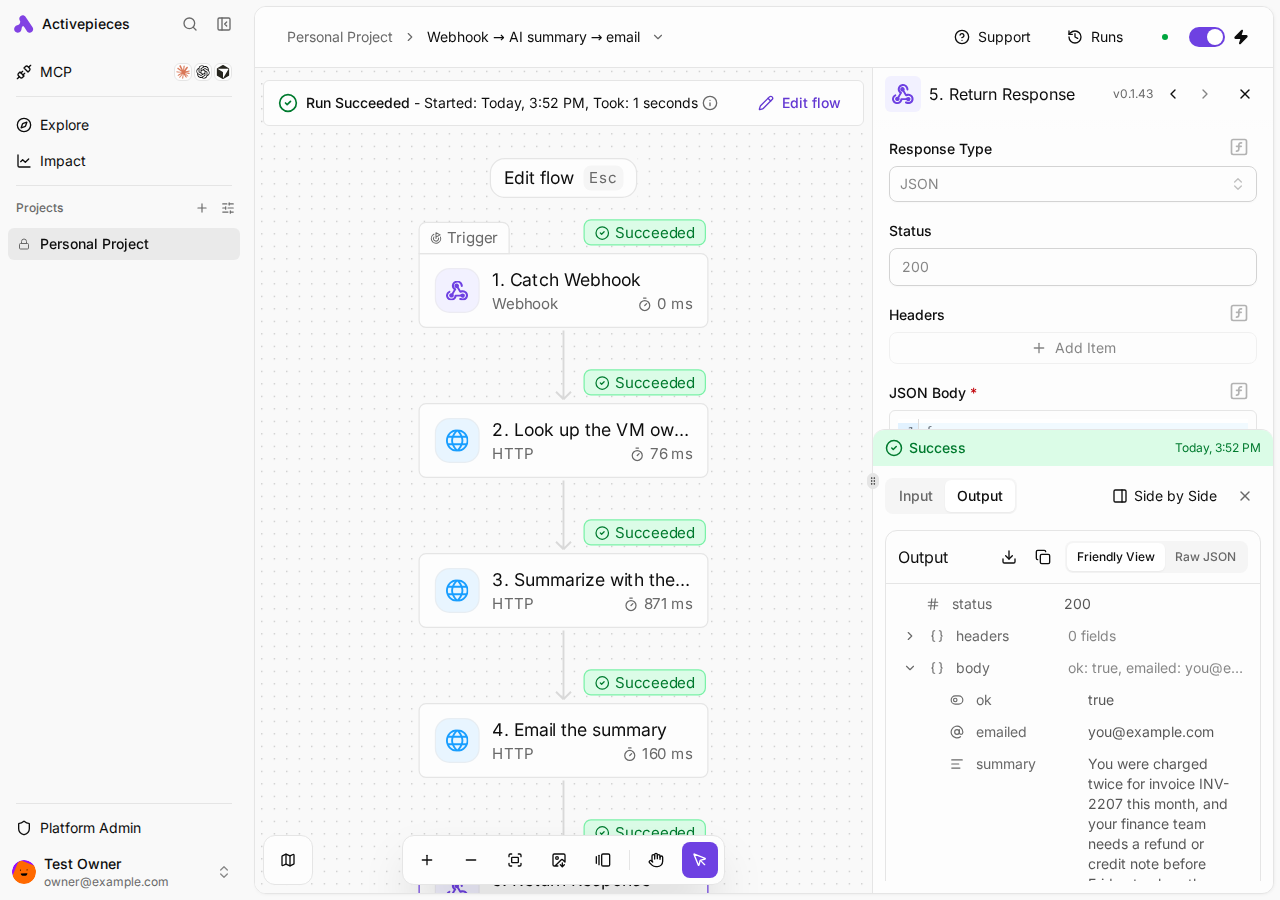
The example flow after one webhook call: an AI summary, emailed to you and returned to the caller in about a second.
## Open the builder
When Shelley finishes, open your builder at
`https://my-activepieces.exe.xyz/`. exe.dev asks you to sign in first,
and lets only you through. Then create your Activepieces account. **The first account becomes the admin**, and only
you can reach the sign-up page, so take your time.
## Run the example flow
Download
[summarize-webhook.json](https://exe-staging.dev/deploy/activepieces/summarize-webhook.json)
to your computer. In Activepieces, open **Automations → Import → Import
Flow**, choose the file, and click **Import**. Then click **Publish**.
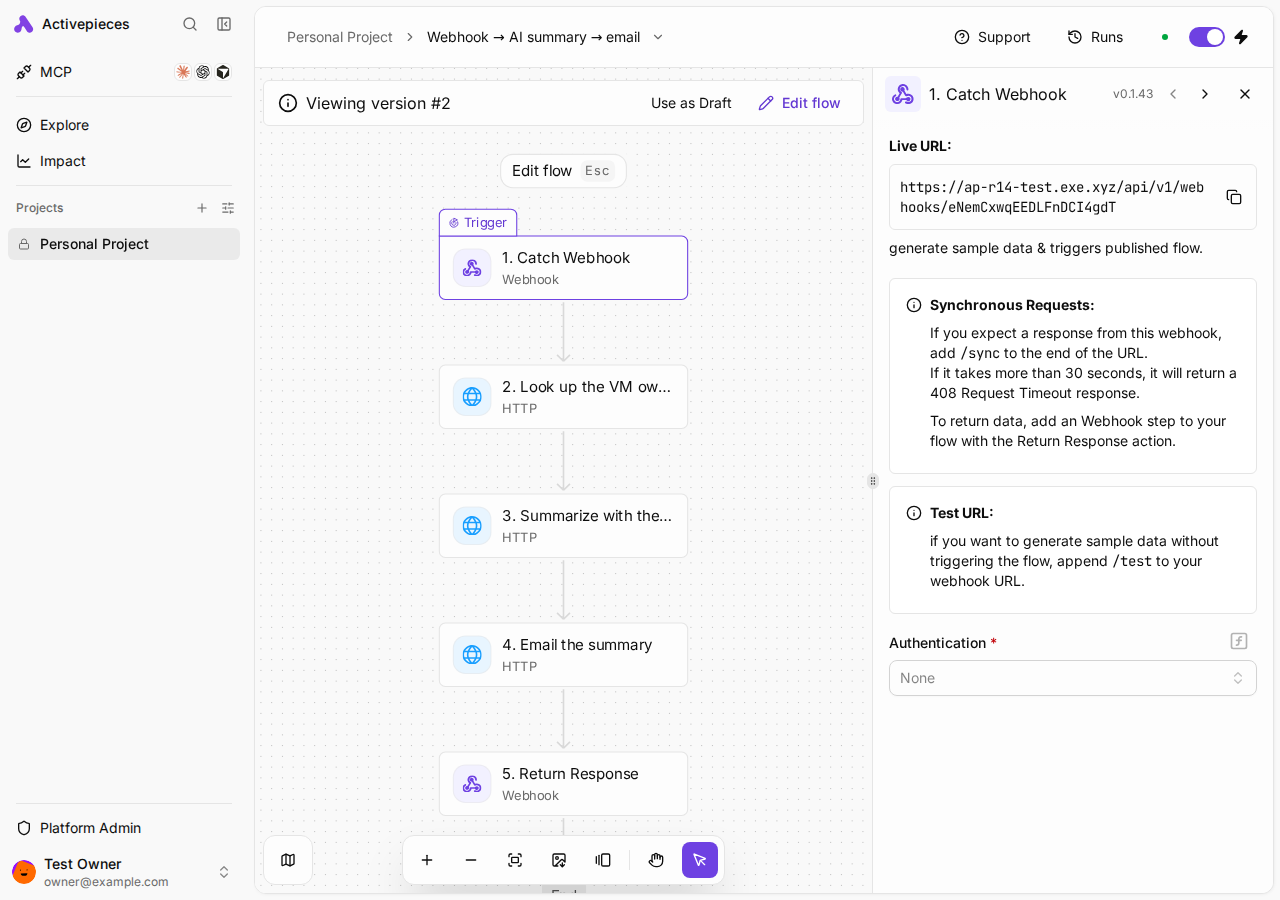
The flow catches a webhook, asks the exe.dev
[LLM gateway](/docs/integrations-llm) for a summary, emails it to you
with the [email gateway](/docs/send-email), and returns it. Every step is
a plain HTTP request: no connections, no keys.
Click the **Catch Webhook** step and copy its **Live URL**; the last part
is your flow's ID. On the VM (`ssh my-activepieces.exe.xyz`), with your ID:
```bash
curl -X POST http://localhost:8000/api/v1/webhooks/YOUR_FLOW_ID/sync \
-H 'Content-Type: application/json' \
-d '{"subject":"Order 1042","text":"My order 1042 still has not shipped and I need it before the weekend. Can you check?"}'
```
You'll get `"ok":true` and a summary back within seconds, and the same
summary lands in your inbox. **Runs** shows each step's input and output.
Without `/sync`, the call returns at once and the flow runs in the
background.
The imported flow. Webhook URLs already use your VM's HTTPS address.
## Let webhooks and AI agents in
Only using schedules and polling triggers? Skip this. To accept calls from
other apps, or connect Claude Code from your laptop, make the VM public.
On your computer:
```bash
ssh exe.dev share set-public my-activepieces
curl -X POST https://my-activepieces.exe.xyz/api/v1/webhooks/YOUR_FLOW_ID/sync \
-H 'Content-Type: application/json' -d '{"subject":"Hi","text":"Hello from outside."}'
```
**The builder stays private.** The nginx gate in front of Activepieces
lets anonymous visitors reach only webhooks, the MCP endpoint with its
OAuth sign-in, and a health check; everything else needs your exe.dev
login. Anyone with a webhook URL can call it, so give webhooks that do
real work **Authentication** (basic, header, or HMAC) on the Catch
Webhook step. Undo with `ssh exe.dev share set-private my-activepieces`.
> [!TIP]
> Calling a webhook from your own scripts only? Keep the VM private and
> send a [VM token](/docs/https-tokens-for-vms) instead:
> `ssh exe.dev ssh-key generate-api-key --vm=my-activepieces --label=flows`,
> then add `-H "X-Exedev-Authorization: Bearer $TOKEN"` to the curl.
## Use AI pieces
The built-in AI piece (Ask AI, Summarize Text, Classify Text, Extract
Structured Data) needs a provider. Open **Platform Admin → AI Center**,
click **Add key** on **Other (OpenAI Compatible)**, and fill in:
- **Name:** exe.dev LLM gateway
- **Base URL:** `https://llm.int.exe.xyz/v1`
- **API key:** anything, such as `exe-dev`; the gateway ignores it
- **API style:** Chat completions
Save, open its **Models** tab, add `gpt-5.4-mini` (type Text), and save
again. AI steps can now pick it. Other ids the gateway serves, such as
`gpt-5.5`, work the same way.
## Connect Claude Code or Codex
Activepieces is an MCP server: an agent can list, build, publish and run
your flows, as you. It needs public access (above); Activepieces checks
an OAuth token on every call. On your computer:
```bash
claude mcp add --transport http activepieces https://my-activepieces.exe.xyz/mcp/platform
claude mcp login activepieces
```
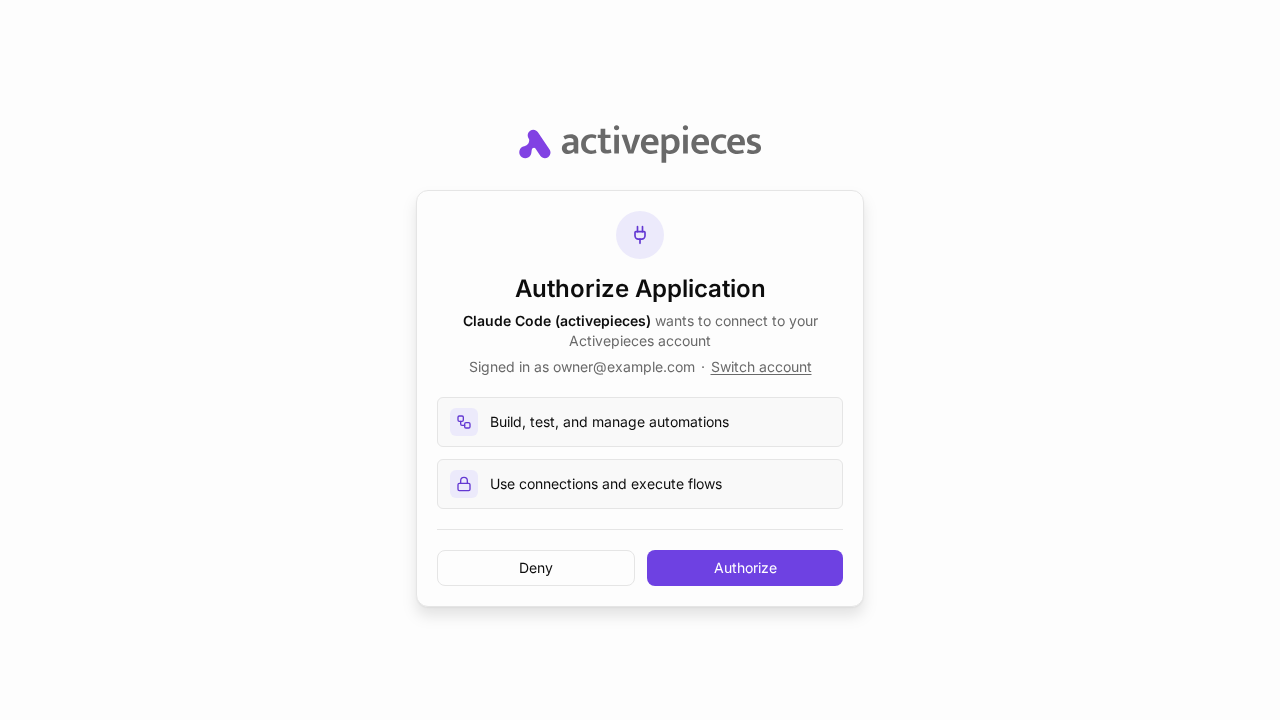
Your browser opens Activepieces' consent page (behind your exe.dev login).
Click **Authorize**, then ask Claude Code “What Activepieces tools do you
have?” or “Run my summarize flow with a test message.” For Codex:
```bash
codex mcp add activepieces --url https://my-activepieces.exe.xyz/mcp/platform
codex mcp login activepieces
```
Signing Claude Code in. Sign-ins last 30 days; revoke one any time under MCP → Connections.
The **MCP** page has steps for Cursor, VS Code and more. Under
**Platform Admin → MCP Server**, edit, run and **delete** tools all start
switched on; turn off **Delete** unless you want an agent able to remove
flows.
## Connect Slack, GitHub, and other apps
Slack, GitHub, Google and most OAuth pieces use Activepieces' own OAuth
apps: click **New connection** and sign in. The token passes through
`secrets.activepieces.com` once, then stays encrypted on your VM. For
your own OAuth app, use `https://my-activepieces.exe.xyz/redirect` as the
redirect URL. Or skip tokens on the VM: an HTTP step can post
`{"text": "..."}` to the exe.dev
[Slack integration](/docs/integrations-slack), or call any API through an
[HTTP proxy integration](/docs/integrations-http-proxy).
## Code steps run in a sandbox
Code steps run in `SANDBOX_CODE_ONLY` mode: each gets its own V8 isolate
with 128 MB and no filesystem, so no `require()` or npm packages. Need
packages, and you're the only builder? Set
`AP_EXECUTION_MODE=UNSANDBOXED` in `.env` and run `docker compose up -d`;
code then runs with the worker's full access.
## Activepieces or n8n?
Both are visual automation tools with AI steps and public webhooks;
Activepieces is MIT-licensed with a simpler, Zapier-like builder and a
built-in MCP server, while n8n has more nodes and lower-level control under
its Sustainable Use License. Prefer n8n? See [Self-host n8n](/deploy/n8n-2)
or the [n8n 3.0 beta](/deploy/n8n-3).
## Keep your work
A backup of the database and settings runs nightly into
`~/activepieces-backups`. Keep a copy **off the VM**. On your computer:
```bash
scp -r my-activepieces.exe.xyz:activepieces-backups .
```
Keep them private: `.env` holds `AP_ENCRYPTION_KEY`, without which saved
connections can't be decrypted. For whole-VM snapshots, see
[VM backups](/docs/vm-backups).
Good to know:
- **CPU only, one worker** running five flows at once; for more, resize
the VM and raise `AP_WORKER_CONCURRENCY` in `.env`.
- **Disk:** images take about 4 GB and run history grows (`df -h /`).
- **HTTP only.** The [HTTPS proxy](/docs/proxy) carries web traffic; to
reach services on your private network, use
[Tailscale](/docs/integrations-tailscale-wif).
- Webhooks time out after 30 seconds and accept up to 25 MB.
Something stuck? On the VM, try
`cd ~/activepieces && docker compose logs --tail=100 app worker`.
## The nuts and bolts
Happy clicking Deploy? You can stop here. These are the same setup steps
Shelley follows, plus the maintenance commands for later.
Install by hand
### Create a VM
On your computer (pick another name if `my-activepieces` is taken):
```bash
ssh exe.dev new --name=my-activepieces
ssh my-activepieces.exe.xyz
```
All remaining installation commands run **on the VM**, as `exedev`.
Commands use `hostname`, so your VM can have any name.
### Install Activepieces
Enable Docker at boot, so the containers come back after a reboot, and
install `jq` if needed:
```bash
sudo systemctl enable --now docker.service
systemctl is-enabled docker.service
command -v jq >/dev/null || sudo apt-get install -y jq
```
The check should print `enabled`. Generate the settings and secrets
**once**; this leaves an existing `.env` alone. It pins Activepieces 0.93,
picks the MIT Community Edition, sandboxes code steps, and turns off
telemetry:
```bash
mkdir -p ~/activepieces/postgres ~/activepieces/redis ~/activepieces/cache
cd ~/activepieces
if [ ! -e .env ]; then
touch .env && chmod 600 .env
cat >> .env < ~/activepieces/compose.yaml <<'EOF'
# Activepieces app + worker + PostgreSQL + Redis + an nginx gate.
# Settings and secrets come from .env in this directory.
name: activepieces
services:
app:
image: ghcr.io/activepieces/activepieces:${AP_VERSION}
restart: unless-stopped
env_file: .env
environment:
- AP_CONTAINER_TYPE=APP
volumes:
- ./cache:/usr/src/app/cache
depends_on: [postgres, redis]
worker:
image: ghcr.io/activepieces/activepieces:${AP_VERSION}
restart: unless-stopped
env_file: .env
environment:
- AP_CONTAINER_TYPE=WORKER
- AP_FRONTEND_URL=http://app
volumes:
- ./cache:/usr/src/app/cache
depends_on: [app]
postgres:
image: pgvector/pgvector:0.8.0-pg14
restart: unless-stopped
environment:
- POSTGRES_DB=${AP_POSTGRES_DATABASE}
- POSTGRES_USER=${AP_POSTGRES_USERNAME}
- POSTGRES_PASSWORD=${AP_POSTGRES_PASSWORD}
volumes:
- ./postgres:/var/lib/postgresql/data
redis:
image: redis:7.0.7
restart: unless-stopped
volumes:
- ./redis:/data
proxy:
image: nginx:stable-alpine
restart: unless-stopped
ports:
- "8000:80"
volumes:
- ./nginx.conf:/etc/nginx/conf.d/default.conf:ro
depends_on: [app]
EOF
```
### Put the builder behind your login
exe.dev's [HTTPS proxy](/docs/proxy) sends `https://.exe.xyz/` to port
8000. While the VM is private, only you get through. Once it's public,
this nginx gate keeps the builder yours: it lets webhook, MCP, and OAuth
paths through, and checks the `X-ExeDev-Email` header that exe.dev
[adds for signed-in visitors](/docs/login-with-exe) against the VM
owner's address, which it looks up with the
[Reflection integration](/docs/integrations-reflection):
```bash
OWNER=$(curl -fsS https://reflection.int.exe.xyz/email | jq -r .email)
echo "$OWNER"
cat > ~/activepieces/nginx.conf <<'EOF'
# Port 8000: https://.exe.xyz/. Webhooks, the MCP server (which has
# its own OAuth), and the health check are open once you run
# `share set-public`; everything else needs the owner's exe.dev login.
map $http_x_exedev_email $ap_gate {
"" login;
"OWNER_EMAIL" ok;
default deny;
}
server {
listen 80 default_server;
absolute_redirect off;
server_tokens off;
# Look the app up at request time, so a recreated container is found.
resolver 127.0.0.11 valid=10s ipv6=off;
set $ap http://app:80;
client_max_body_size 30m;
proxy_http_version 1.1;
proxy_read_timeout 300s;
proxy_set_header Host $host;
proxy_set_header Upgrade $http_upgrade;
proxy_set_header Connection $http_connection;
proxy_set_header X-Forwarded-For $http_x_forwarded_for;
proxy_set_header X-Forwarded-Host $http_x_forwarded_host;
proxy_set_header X-Forwarded-Proto $http_x_forwarded_proto;
# Public: /api/v1/webhooks/[/sync|/test|/draft|/draft/sync].
# Check the raw path too, so encoded tricks can't reach anything else.
location ^~ /api/v1/webhooks/ {
if ($request_uri !~ "^/api/v1/webhooks/[A-Za-z0-9_-]+(/sync|/test|/draft|/draft/sync)?/?(\?.*)?$") {
return 404;
}
proxy_pass $ap;
}
# Public: the MCP server and its OAuth endpoints. Activepieces checks
# every token; the consent page stays behind the login.
location = /mcp { proxy_pass $ap; }
location = /mcp/platform { proxy_pass $ap; }
location = /register { proxy_pass $ap; }
location = /authorize { proxy_pass $ap; }
location = /token { proxy_pass $ap; }
location = /revoke { proxy_pass $ap; }
location = /userinfo { proxy_pass $ap; }
location ^~ /.well-known/ { proxy_pass $ap; }
location = /api/v1/health { proxy_pass $ap; }
# Everything else (the builder, its API and websocket): the owner only.
location / {
if ($ap_gate = login) {
return 302 /__exe.dev/login?redirect=$request_uri;
}
if ($ap_gate = deny) {
return 403 "This Activepieces belongs to someone else.\n";
}
proxy_pass $ap;
}
}
EOF
sed -i "s/OWNER_EMAIL/$OWNER/" ~/activepieces/nginx.conf
grep -c "\"$OWNER\"" ~/activepieces/nginx.conf
```
The first line prints your email and the last prints `1`. To let a second
person in, add another `"them@example.com" ok;` line to the `map`, then
run `docker compose restart proxy`.
### Start it
```bash
cd ~/activepieces
docker compose up -d
until curl -fs http://localhost:8000/api/v1/health; do sleep 5; done; echo
```
The first start pulls about 4 GB of images and takes a few minutes. Expect
`{"status":"Healthy"}`. Activepieces then downloads its catalog of
pieces, which takes another minute or two; flows can't be imported or
published until the pieces they use have arrived:
```bash
cd ~/activepieces
until [ "$(docker compose exec -T postgres psql -U postgres -d activepieces -Atc \
"select count(*) from piece_metadata where name = '@activepieces/piece-webhook'")" -gt 0 ]; do sleep 10; done
echo pieces ready
```
Then check the gate:
```bash
curl -s -o /dev/null -w '%{http_code}\n' http://localhost:8000/
curl -s -o /dev/null -w '%{http_code}\n' -H 'X-ExeDev-Email: someone@example.com' http://localhost:8000/
curl -s -o /dev/null -w '%{http_code}\n' -H "X-ExeDev-Email: $(curl -fsS https://reflection.int.exe.xyz/email | jq -r .email)" http://localhost:8000/
```
Expect `302` (to the login), `403`, and `200`. exe.dev replaces any
`X-ExeDev-Email` header a visitor sends, so these can't be faked from
outside. Confirm every service restarts on its own:
```bash
docker compose ps --format '{{.Service}} {{.Status}}'
docker inspect --format '{{.Name}} {{.HostConfig.RestartPolicy.Name}}' $(docker compose ps -q)
```
Five services `Up`, each `unless-stopped`.
### Set up nightly backups
The backup dumps the database without the piece catalog (about 600 MB
that Activepieces downloads again on start) and archives the settings
next to it:
```bash
mkdir -p ~/activepieces-backups
cat > ~/activepieces/backup.sh <<'EOF'
#!/bin/sh
# Nightly Activepieces backup: database dump plus the settings it needs.
set -eu
umask 077
cd ~/activepieces
. ./.env
out=~/activepieces-backups
stamp=$(date +%F)
docker compose exec -T postgres pg_dump -U "$AP_POSTGRES_USERNAME" -d "$AP_POSTGRES_DATABASE" --clean --if-exists \
--exclude-table-data=piece_metadata --exclude-table-data=piece_translation | gzip > "$out/activepieces-$stamp.sql.gz"
tar czf "$out/activepieces-config-$stamp.tgz" .env compose.yaml nginx.conf backup.sh
find "$out" -name 'activepieces-*' -mtime +14 -delete
echo "$out/activepieces-$stamp.sql.gz"
EOF
chmod +x ~/activepieces/backup.sh
~/activepieces/backup.sh
(crontab -l 2>/dev/null | grep -v activepieces/backup.sh; echo '17 3 * * * $HOME/activepieces/backup.sh >/dev/null') | crontab -
crontab -l | grep backup.sh
```
The script prints the new dump's path; backups older than 14 days are
deleted.
### Test a backup
Load the latest dump into a throwaway PostgreSQL container and list the
published flows:
```bash
latest=$(ls -t ~/activepieces-backups/activepieces-*.sql.gz | head -1)
docker run -d --name ap-restore-test -e POSTGRES_PASSWORD=restore-test \
-e POSTGRES_DB=activepieces pgvector/pgvector:0.8.0-pg14
docker exec ap-restore-test sh -c 'until pg_isready -q -h 127.0.0.1; do sleep 1; done'
zcat "$latest" | docker exec -i ap-restore-test psql -q -v ON_ERROR_STOP=1 -U postgres -d activepieces >/dev/null && echo restored
docker exec ap-restore-test psql -U postgres -d activepieces -Atc 'select count(*) from flow'
docker rm -f ap-restore-test
```
Expect `restored` and a count (`0` before anyone has built a flow).
Installation done. Leave the Activepieces account and public sharing to
the owner; continue with [Open the builder](#open-the-builder).
Back up and restore
On the VM, `~/activepieces/backup.sh` makes an extra backup. A restore
needs the database dump **and** the `.env` from the same day's config
archive. Copy backups off the VM as shown above.
### Restore
On a new VM, follow [Install Activepieces](#install-activepieces) as far as
enabling Docker, then copy both files over from your computer, using your
backups' actual names:
```bash
ssh my-activepieces.exe.xyz mkdir -p activepieces-backups
scp activepieces-2026-11-21.sql.gz activepieces-config-2026-11-21.tgz my-activepieces.exe.xyz:activepieces-backups/
```
The rest runs **on the VM**. If Activepieces already runs there, stop it and
keep its directory aside first:
```bash
cd ~/activepieces && docker compose down
sudo mv ~/activepieces ~/activepieces.before-restore
```
Unpack the settings, point them at this VM, and refresh the owner email in
the gate:
```bash
mkdir -p ~/activepieces/postgres ~/activepieces/redis ~/activepieces/cache
cd ~/activepieces
tar -xzf ~/activepieces-backups/activepieces-config-2026-11-21.tgz
sed -i "s#^AP_FRONTEND_URL=.*#AP_FRONTEND_URL=https://$(hostname).exe.xyz#" .env
OWNER=$(curl -fsS https://reflection.int.exe.xyz/email | jq -r .email)
sed -i "s/^\( \"\)[^\"]*\(\" ok;\)/\1$OWNER\2/" nginx.conf
grep ' ok;' nginx.conf
```
Load the database before starting Activepieces:
```bash
cd ~/activepieces
. ./.env
docker compose up -d postgres
until docker compose exec -T postgres pg_isready -q -h 127.0.0.1; do sleep 2; done
zcat ~/activepieces-backups/activepieces-2026-11-21.sql.gz \
| docker compose exec -T postgres psql -q -v ON_ERROR_STOP=1 -U "$AP_POSTGRES_USERNAME" -d "$AP_POSTGRES_DATABASE" >/dev/null && echo restored
```
Start the app on its own first, so it can download the piece catalog
again (5 to 15 minutes). Without the worker and proxy, no flow runs
meanwhile: a flow that ran before its pieces arrived would be switched
off.
```bash
cd ~/activepieces
docker compose up -d app
until docker compose logs app 2>&1 | grep -q 'Piece synchronization completed'; do sleep 15; done
docker compose up -d
until curl -fs http://localhost:8000/api/v1/health; do sleep 5; done; echo
```
Sign in with your old Activepieces account: flows, runs and connections
are back. Recreate the backup cron from
[Set up nightly backups](#set-up-nightly-backups), and run `share
set-public` again if you used it. Webhook URLs change if the VM's name
did. Keep `~/activepieces.before-restore` until you're happy.
Update Activepieces
Pick a version from the
[releases](https://github.com/activepieces/activepieces/releases) and read
its notes. On the VM, back up, then change **only `AP_VERSION`** in `.env`:
```bash
cd ~/activepieces
./backup.sh
nano .env
docker compose pull
docker compose up -d
until curl -fs http://localhost:8000/api/v1/health; do sleep 5; done; echo
docker compose logs app | grep -o -m1 '"version":"[^"]*"'
```
The app migrates the database on start. Try your flows. To roll back,
[restore the backup](#restore); changing the image tag alone won't undo
database migrations. Run `docker image prune` afterwards to get the old
images' disk space back.
Something not working?
On the VM:
```bash
cd ~/activepieces
docker compose ps
docker compose logs --tail=100 app worker proxy
```
- **403 “belongs to someone else”:** you're signed in to exe.dev with a
different email than the VM owner's. Add yours to the `map` in
`nginx.conf` and run `docker compose restart proxy`.
- **Edited `nginx.conf` but nothing changed:** `docker compose restart
proxy`. Docker keeps reading the old file if an editor replaced it.
- **Webhook returns 401 from outside:** the VM is still private. Run
`ssh exe.dev share set-public my-activepieces` on your computer, or send
a VM token.
- **“Trigger not found for piece” on import or publish:** the piece catalog
is still downloading after a fresh start or restore. Wait a minute or
two and try again.
- **Webhook returns 404:** publish the flow, and check the flow ID. For
sample data while building, use the `/test` URL.
- **“The flow has failed and there is no response returned”:** open
**Runs** to see which step failed and why. In expressions, refer to
earlier steps as `{{step_1['output']['body']}}` or pick them from the
data selector.
- **AI step says no provider:** add the gateway in **AI Center** and
add a model, as in [Use AI pieces](#use-ai-pieces).
- **Claude Code can't connect:** the VM must be public for MCP; `curl -s
https://my-activepieces.exe.xyz/.well-known/oauth-authorization-server`
should return JSON.
- **Connections fail to decrypt after a restore:** `.env` doesn't match the
database. Restore both from the same day.
- **Down after reboot:** run `sudo systemctl enable --now docker.service`.
## Frequently asked questions
### Is Activepieces free to self-host?
The Community Edition used here is MIT-licensed and free. You pay for your VM; see [exe.dev plans](https://exe.dev/pricing). AI steps through the exe.dev LLM gateway are billed through your [LLM integration](/docs/integrations-llm).
### What's missing from the Community Edition?
SSO, audit logs, API keys, secret managers, embedding, and AI agents and chat are paid features. Flows, 750+ pieces, webhooks, tables, AI pieces, code steps and the MCP server all work. The official installer runs the Enterprise edition without a licence, which puts you on a metered free plan; this recipe sets `AP_EDITION=ce` instead.
### Can I use AI models without an OpenAI key?
Yes. Add the exe.dev LLM gateway as an OpenAI-compatible provider in **AI Center**, or call it from an HTTP step as the example flow does. No key to paste.
### Can Claude Code build and run flows for me?
Yes. Activepieces is an MCP server: `claude mcp add --transport http activepieces https://my-activepieces.exe.xyz/mcp/platform`, sign in once, and Claude Code can list, edit, publish and run your flows. Codex, Cursor and other MCP clients work the same way.
### Can I use my own domain?
Yes. Ask Shelley to connect a [custom domain](/docs/cnames), then set `AP_FRONTEND_URL` to it and restart, so webhook URLs and sign-in redirects use the new name.
### How big a VM does it need?
Activepieces asks for 2 vCPUs and 4 GB of memory. On our test VM the whole VM used about 2.5 GB of memory and 8 GB of disk, half of that the container images.
## Related
- [Self-host n8n](https://exe-staging.dev/deploy/n8n-2.md): Connect your apps. Let the boring bits run themselves.
- [Self-host n8n 3.0](https://exe-staging.dev/deploy/n8n-3.md): The next n8n on its own VM. Try 3.0 before it's stable.
- [Run Claude Code on a remote server](https://exe-staging.dev/deploy/claude-code.md): A computer for Claude. A breather for your laptop.
- [Run Codex on a remote server](https://exe-staging.dev/deploy/codex.md): A computer for Codex. An early night for your laptop.
- [Deploy a Docker Compose app from GitHub](https://exe-staging.dev/deploy/docker-compose.md): Your compose.yaml on a VM of its own. git push to deploy.
- [Self-host PostgreSQL](https://exe-staging.dev/deploy/postgres.md): Your own Postgres on a real disk, with backups you've actually restored.